
Bio-Tech
Natural Plant Extracts bring benefits to the health of all human beings for geenrations.
Bio-tech
Technique introduction
In recent years, a variety of new deadly bacteria has emerged one after another. For instance, the COVID-19 pandemic has been infected hundreds of millions of people around the world and the death toll has reached millions. However, the research and development of the vaccine and medicine is far slower than the speed of virus mutation. In addition, cancer has a high mortality rate for a long time and encounters the bottlenecks of the medical research. Although the mechanism of carcinogen is continuously discovered and the therapies are varied rapidly, cancer is still the first of the top-ten death mortality in Taiwan.
To overcome the hazard of deadly bacteria and cancer to human life, the founder of LongServing Technology, Dr. Ko-Cheng Fang, who is in the spirit of helping the world, has deeply studied Chinese, Western and Tibetan medicine. He uses many kinds of natural plant extracts and mixes phytochemicals having the content against cancer and virus. These phytochemicals penetrate into the blood of humans and arrive the location of virus and caner to inhibit their growth.
Research Progress & Objectives
At present, two kinds of compound essence extraction technology have been developed to fight against fatal virus and tumor respectively, and verified by a number of medical experiments and initially achieved excellent results. More relevant research will be carried out in the future to go for the goal of the international pharmaceutical research and development.
Academic Research Results
The natural plant extract developed by LongServing Technology has been confirmed by in vitro cancer cell experiments, which can inhibit the growth of a variety of human cancer cells. At present, the killing test on cancer cells has been carried out for liver cancer and lung cancer, and it is found that Sample significantly inhibits the growth of cancer cells. The detailed experimental results are as follows:
1. Huh7 Human Liver Cancer Cells
Sample has been confirmed by a killing test on in vitro cancer cells that it can inhibit the growth of nearly 100% human liver cancer cells (Huh7 cells) and promote the death of human liver cancer cells.
A killing test on in vitro cancer cell with the Sample was carried in the laboratory to test the ability of Sample in killing cancer cells. In the experiment, the concentration was diluted from 8% to 0.0039%, and nine kinds of concentrations tests were carried out. Besides, the target drug (Sorafenib) for the treatment of liver cancer is as the experimental positive control group. As shown in the figures below , the result shows that Sample inhibits the growth of human liver cancer cells and causes human liver cancer cells to die. When the concentration is 0.5%, the viability of cancer cells is about 0%, which means that nearly 100% cancer cells are killed. In addition, it is calculated that when the sample concentration of Sample is 0.00914%(IC50), 50% cancer cells could be inhibited.
P.S. IC50 is the concentration of medicine required to kill half number of cells after medication.
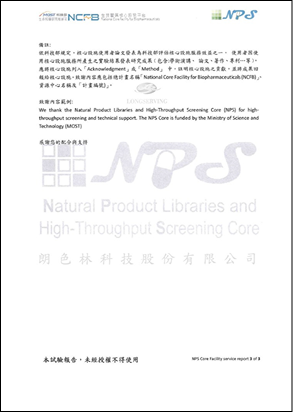
An experimental report about Huh7 cells.
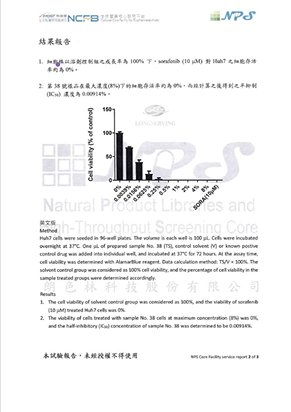
An experimental report about Huh7 cells.
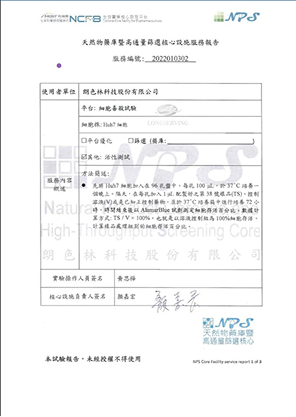
An experimental report about Huh7 cells.
2. A549 Human Lung Cancer Cells
It has been confirmed by a killing test on in vitro cancer cells that it can inhibit the growth of nearly 100% human lung cancer cells (A549 cells) and promote the death of human lung cancer cells.
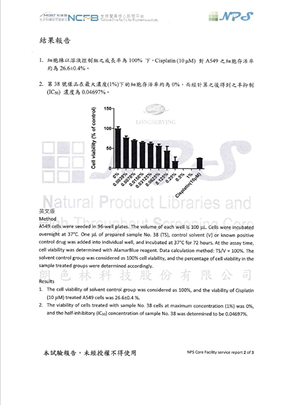
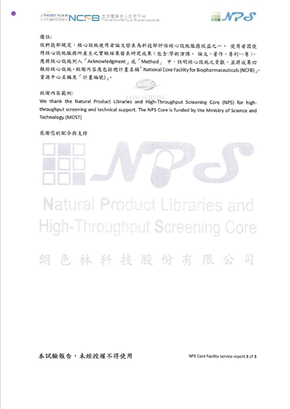
A killing test on in vitro cancer cell with Sample was carried in the laboratory to test the ability of this Sample in killing cancer cells. In the experiment, the concentration was diluted from 1% to 0.0039%, and nine kinds of concentrations tests were carried out. Besides, the target drug (Cisplatin) for the treatment of lung cancer is as the experimental positive control group. As shown in the figures below , the result shows that Sample inhibits the growth of human lung cancer cells and causes human lung cancer cells to die. When the concentration is 0.5%, the viability of cancer cells is about 0%, which means that nearly 100% cancer cells are killed. In addition, it is calculated that when the sample concentration is 0.04697% (IC50), 50% cancer cells could be inhibited.
P.S. IC50 is the concentration of medicine required to kill half number of cells after medication.
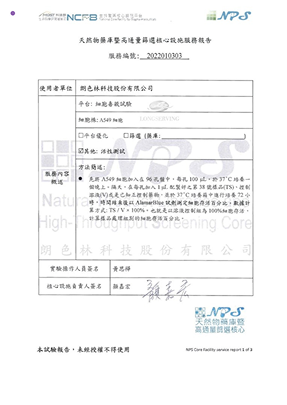
An experimental report about Huh7 cells.
An experimental report about Huh7 cells.
An experimental report about Huh7 cells.
3. Melanoma Cells (A375 Cells)
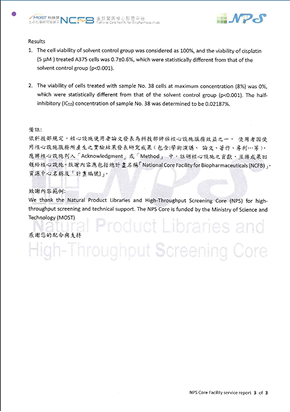
The natural plant extract developed by Longserving has been verified through in vitro cytotoxicity tests to inhibit nearly 100% of the growth of human malignant melanoma cells (A375 cells), thereby inducing the death of these cancer cells.
An in vitro cytotoxicity experiment was conducted in the laboratory to evaluate its effectiveness against cancer cells.
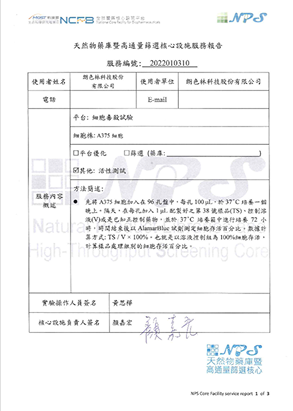
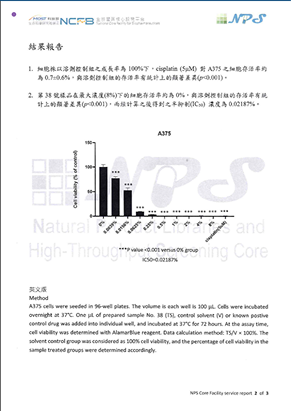
In the experiment, concentrations ranged from 8% diluted down to 0.0039%, covering nine different concentration levels. The chemotherapy drug (Cisplatin), commonly used to treat malignant melanoma, was used as the positive control group. The results (as shown in Figures 1, 2, and 3) indicate that the extract can inhibit the growth of human malignant melanoma cells and promote their death. At a concentration of 0.5%, the survival rate of cancer cells was approximately 0%, demonstrating that nearly 100% of the cancer cells were inhibited. Further calculations showed that at a sample concentration of 0.02187% (IC50), it can inhibit 50% of cancer cell growth.
Note: IC50 refers to the concentration of a drug required to reduce the number of cells by half after treatment.
P.S. IC50 is the concentration of medicine required to kill half number of cells after medication.
An experimental report about Huh7 cells.
An experimental report about Huh7 cells.
An experimental report about Huh7 cells.
Cooperation Plan
Our team has completed preliminary experimental verification and achieved good results in the study of the anticancer activity of compound natural plant extracts. We are currently planning systematic animal experiments and preclinical evaluations, while simultaneously preparing for subsequent human trials and related application procedures. All experiments will be conducted in accordance with animal ethics guidelines and preclinical research standards, striving towards drug market approval. Key innovations of this project include: • Utilizing low-toxicity, active extraction from certified organic plant essential oils
• Nanoscale design with both lipid-soluble and water-soluble properties
• Probe-based precise local tumor delivery strategy
• Significantly reducing the risk of systemic side effects from traditional chemotherapy
We are assembling a team to use this probe technology to lock plant extracts into tumor cells. We welcome major biotech companies to join our team. Of course, we are also seeking financial assistance to shorten the time to market. After all, this is a war of the century against disease, and we welcome any resources we can secure. We welcome interested organizations and partners to contact Longserving Technology.